Elinor Greaves has spent twenty years authenticating manuscripts for institutions that valued their collections as assets. She can detect a forgery at twenty paces and spot a century’s worth of water damage from across the room. What she cannot do, apparently, is read people — a fact that became professionally and personally catastrophic in the same month.
The series follows Elinor through her work as a Manuscript Authenticator at Cinder’s Rest, the neutral-ground library that sits on a river island between two rival kingdoms, staffed by scholars, conservation specialists, an ever-surprising team of fetch-and-carry dogs, and four dragons who have been corresponding about textual disputes for longer than most human institutions have existed.
Each book brings Elinor a new authentication project — texts with political implications, disputed provenance, or histories longer and stranger than anyone anticipated — alongside the continued development of a life she didn’t plan for and now cannot imagine leaving. The work is always real. The dragons always have opinions. The community accumulates, as communities do, into something that sustains.
The Elinor Greaves series is cosy fantasy for readers who find deep satisfaction in dry wit, dragon letters, work that matters, and the particular pleasure of watching a guarded person slowly discover they have been seen clearly all along.
For fans of Heather Fawcett’s Emily Wilde series and Travis Baldree’s Legends & Lattes.
The Elinor Greaves series is available on AMAZON.
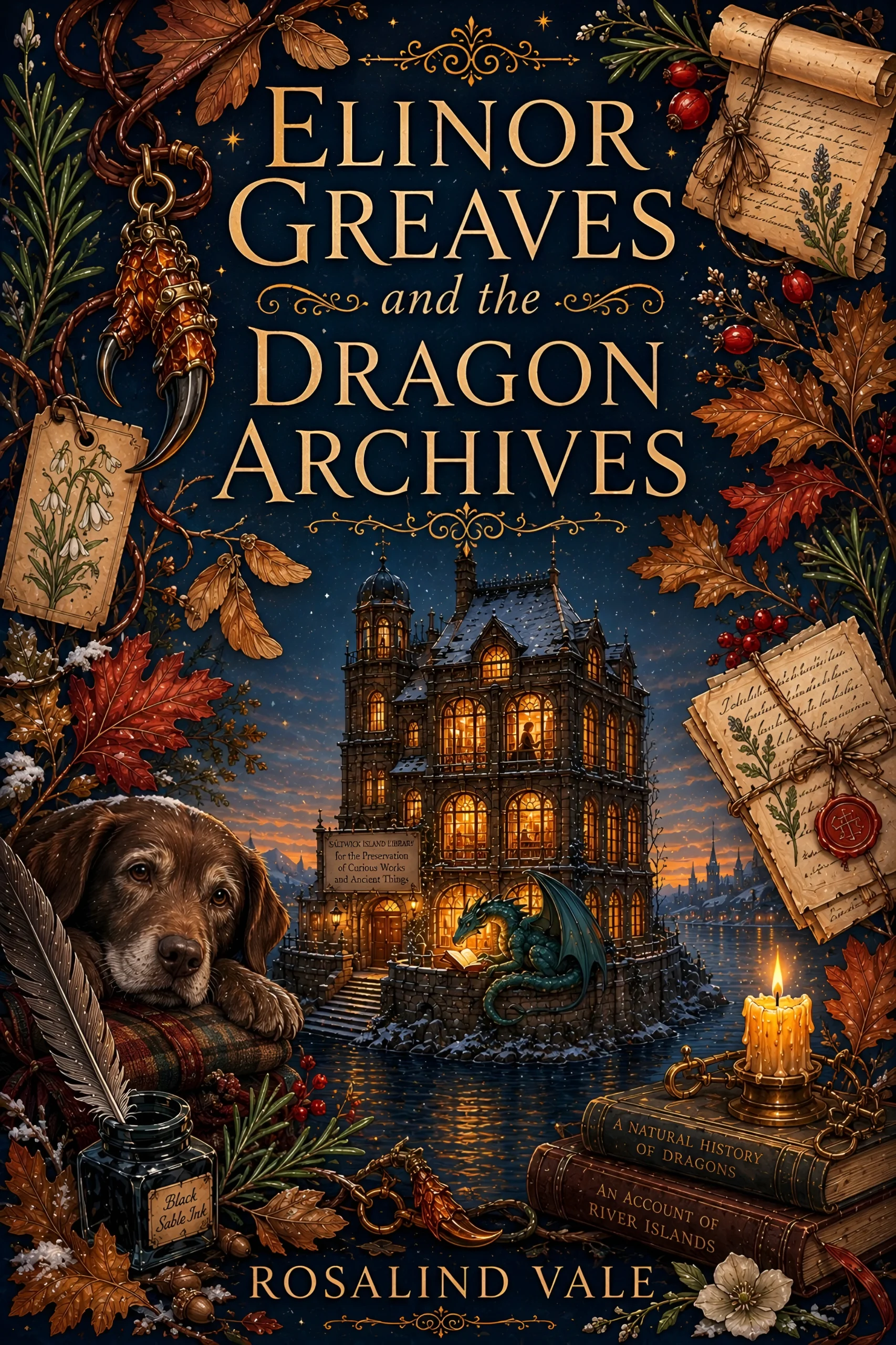
Elinor Greaves and the Dragon Archives
(The Elinor Greaves Series Book 1)Elinor Greaves can spot a forged manuscript at twenty paces. What she cannot do, at forty-four, after the year she’s had, is trust a smile.
So, when a three-month contract arrives to authenticate a disputed dragon text at Cinder’s Rest — a neutral library on a river island between two kingdoms — it seems like exactly what she needs: quiet work, no complications, and somewhere to recover that isn’t home. She expects ink and cold air and professional distance. She gets an anxious dragon who writes twenty-three-page letters about minor textual variants. She gets an elderly chocolate Labrador who chooses her on sight and declines to be dissuaded. She gets a community of librarians, dog handlers and conservation specialists who are, against all reasonable expectation, simply kind.She is deeply suspicious of all of it.
When the authentication work turns up something she didn’t expect, she discovers something about herself she never knew, and the kindness doesn’t stop — not when she pulls away to test it, not when everything becomes complicated, not even when it would be considerably more convenient if it did.Elinor Greaves and the Dragon Archives is a cozy fantasy about learning to read people the way you read manuscripts: carefully, with attention to detail, trusting the evidence rather than fearing a single devastating mistake. It’s about finding work that matters and dragons who correspond formally and a community where the operating principle is quiet, unannounced care. Travel with Elinor to an island library in winter, where the river freezes at the edges and woodsmoke is constant and the deep archives are warm because the texts down there are tended by dragons and have been read with love for a thousand years.
This book is about arriving somewhere temporary and finding, without quite meaning to, that you’ve built a life that brings you joy.For readers of Emily Wilde’s Encyclopaedia of Faeries and Legends & Lattes. Featuring: scholarly dry wit, patient romance, dragons who file correspondence in emotional-resonance order, and one very perceptive elderly dog.

Elinor Greaves and the Dragon’s Promise
(The Elinor Greaves Series Book 2)
Elinor Greaves has done the impossible. She has stopped moving.
She has a title, a desk with a view of the river, a dragon who communicates in single words and somehow means everything, a partner who makes her tea exactly right without being asked, and rosemary on the windowsill. For a woman who spent forty-four years armoured against disappointment, this is an extraordinary situation. She does not entirely have a methodology for it.
But when a notation surfaces in a property transfer — a box of research materials waiting in an ancient family archive across the water — Elinor discovers that belonging has a second question. Not can you find a home? But what does home ask of you once you have it?
What home asks, it turns out, is that she finish what her predecessor began.
Leaving Cinder’s Rest for the ancient noble houses of Elvenglade means navigating a summer estate full of her partner’s family (warm, numerous, inclined to cry at ceremonies), corresponding with dragons who have opinions about a 183-year-old egg that is about to hatch, and a text so old and so resistant that no one has been able to read it and suddenly her usual authentication methods refuse to work.
It means understanding, slowly, that the work left unfinished was always going to require someone who had learned how to stay.
Elinor Greaves and the Dragon’s Promise is a cosy fantasy for readers who believe that stillness takes courage, that finishing someone else’s work can be an act of love, and that the most interesting things can happen when a dragon hatchling decides you belong to it.
Warm, wry, and full of ink-stained wonder — perfect for fans of Legends & Lattes, Emily Wilde’s Encyclopaedia of Faeries, and the pleasure of a book that smells faintly of old parchment and summer rain.

Elinor Greaves and The One Who Listened
(The Elinor Greaves Series Book 3)
Elinor Greaves has never been more at home.
The rosemary is on the windowsill. The traveller’s elm cutting has finally been potted. Clawdius sleeps at the south end of the cottage, grey-muzzled and unhurried, and the community at Cinder’s Rest has become the kind of place that exists in her chest when she is away from it. After two novels’ worth of careful, hard-won belonging, Elinor has arrived — and she knows it.
Then a name surfaces in the Whitmore collection.
The one who listened. A vacancy in the oldest records of the island, traced through two hundred and forty-three letters spanning forty-three years of a scholar’s correspondence. A parallel record in an unidentified hand. And then, quietly, something else: annotations begin to appear unexpectedly in the deepest archive texts — noticed first by a dragon hatchling, who has been sleeping at the archive entrance before dawn, attentive to something none of the library’s dogs can name.
Elinor has the finest tools in the profession. She has built a methodology meticulous enough to authenticate a disputed manuscript from the feel of the page. But the ancient presence she uncovers predates the dragons. It predates her tools. It predates writing. And it has apparently noticed that it is being investigated.
Elinor Greaves and the One Who Listened sends Elinor to Elvenglade for a wedding and a conversation she promised an eighty-four-year-old archivist who holds knowledge that cannot be written down, brings a legend from Storm Peaks to her table who turns out to be someone she once walked to safety after setting fire to an Earl’s trousers, and asks her, for the first time, to read something that predates reading. The investigation will require her to trust what cannot be documented. It will also require her to understand — slowly, reluctantly, and with considerable marginal annotation — that she is not only the end of a line.
She is the beginning of one.
Elinor Greaves and the One Who Listened is the warm, deeply satisfying conclusion to a trilogy about finding home, choosing it again, and learning that some records are kept not in ink but in the quiet act of paying attention. For readers of Shelley Parker-Chan, T. Kingfisher, and Travis Baldree.


